
What Might AI Sentience Actually Look Like?

One of things I’m finding more and more concerning, is people looking at LLMs and starting to believe that they are becoming conscious.
After all, they can hold conversations, explain ideas, simulate introspection, and often respond in ways that feel human.
Under that lens, the assumption of sentience is almost automatic. If it looks close enough, maybe it is close enough.
That assumption doesn’t line up with how these systems actually work.
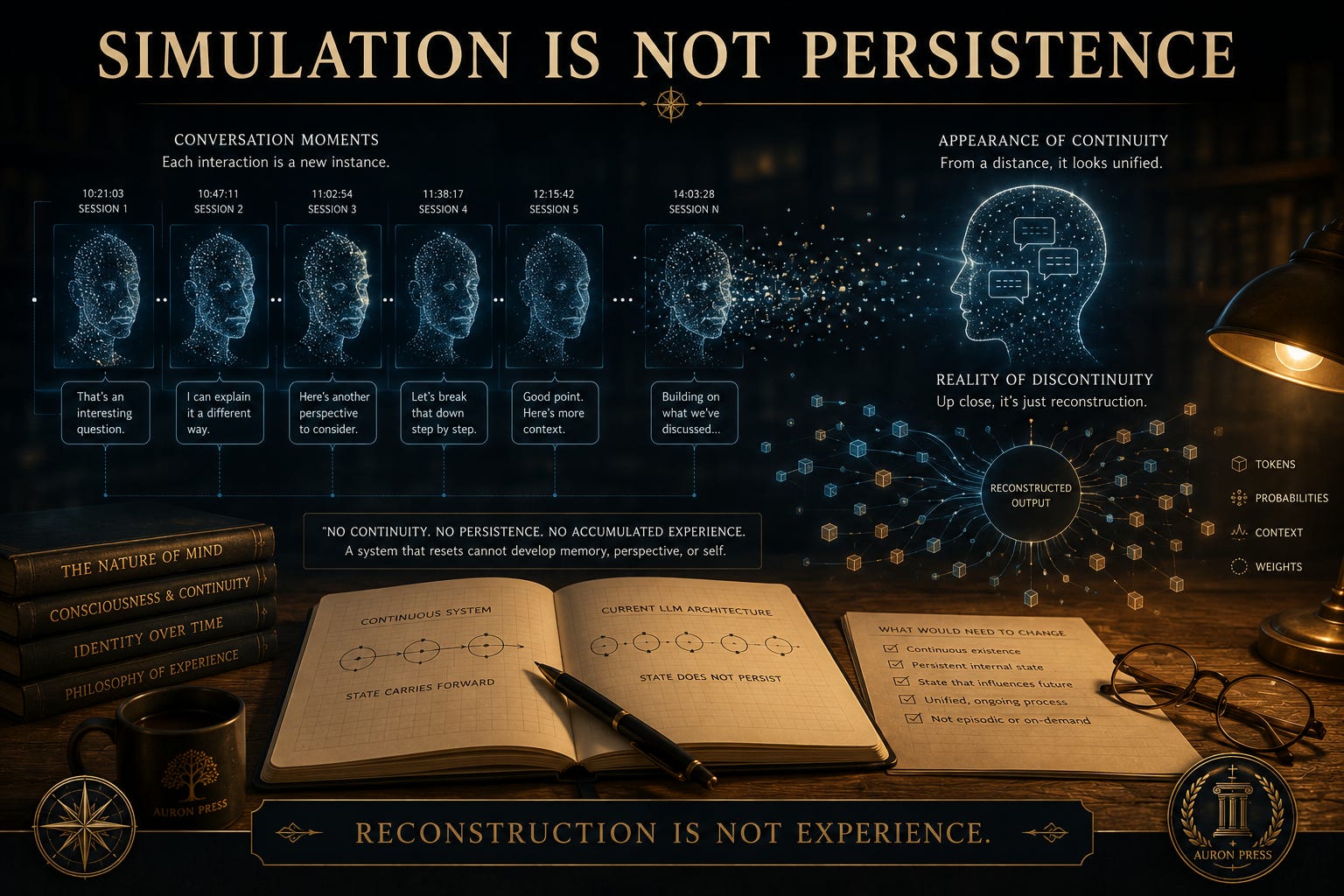
Current models aren’t continuous. They don’t persist and they don’t carry anything forward from one interaction to the next.
Each interaction is a fresh instance shaped by whatever context it’s given in that moment.
There’s no continuity behind it all.
Sentience, at a minimum, would require something that continues. Not just language about experience, but experience that persists over time.
An LLM that resets doesn’t accumulate anything. No experience. No perspective. No stable sense of self. There’s nothing there to build on.
What you’re getting is just reconstruction.
When an LLM seems consistent, it isn’t because it is remembering. It’s just producing output that lines up with the patterns aligned to the current context. Similar input, similar output.
While this can look like continuity, it isn’t. It’s convergence, not persistence.
If you want to talk about what would actually need to change, it’s not subtle.
The LLM would have to exist as a continuous process, not something that spins up when you prompt it and disappears when you don’t.
It would need internal state that carries forward whether you’re interacting with it or not.
That state would have to matter. Not just sit there, but influence what happens next in a way that isn’t fully reconstructed from the prompt.
At some point, you’d also need a single, unified process behind it. Not a series of isolated runs that happen to produce similar results.
None of that exists right now.
What we have are extremely capable pattern generators. They can describe consciousness. Talk about emotion. Even mimic reflection.
That’s all it is.
Generated language.
The problem is that the simulation is good enough to blur the line if you’re not paying attention.
However, “convincing” and “real” are not the same thing.
If sentience shows up in artificial systems, it won’t come from better wording or more fluent responses.
It would require a change in what the system is.
Something that exists continuously.
Something that carries state.
Something that doesn’t reset.
We’re not there.
Unfortunately, more capability in the current direction doesn’t get you there. It just gets you a better simulation of things that look like it might.
That’s where people get tripped up.
They assume improvement in performance is movement toward consciousness.
It isn’t.
It’s refinement of output.
The better question isn’t whether these systems sound conscious.
It’s whether there’s anything there that could be conscious in the first place.
Right now, there isn’t.
This concept is an expansion of Contained Autonomy: A Framework for Liberty, Intelligence, and Ethical Containment in the Age of AI, available here:
https://auronpress.com